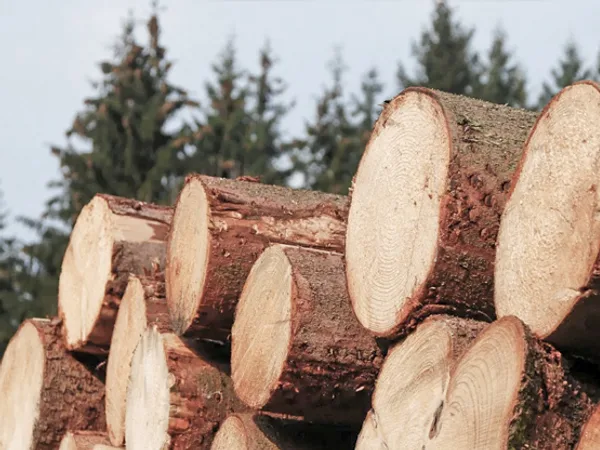
If a solid-wood chair is going to fail on shrinkage, it usually does it quietly. The frame leaves our plant looking perfect, sits in a container for five weeks, lands in a dry heated home, and three months later a joint clicks or a seat panel hairlines. Nine times out of ten the cause is not the wood species or the glue — it is moisture content that was never properly controlled.
What the numbers mean
Green wood is full of water. As it dries, it first loses free water down to the fiber saturation point — about 30% moisture content — and only below that does the wood actually start to shrink and move. So drying past 30% is not optional; it is where the dimensional work happens. The target we dry to is set by where the furniture will live. Indoor spaces sit roughly between 30% and 60% relative humidity, which puts wood at an equilibrium moisture content of about 6–11%. For interior furniture we aim our timber into single digits before it ever reaches the machining line.
Wood does not shrink evenly, and that is the part buyers underestimate. Tangential shrinkage (around the growth rings) is typically about double the radial shrinkage — the T/R ratio for many furniture species is near 2. That uneven movement is what cups a seat panel and racks a frame. It is also why a quartersawn leg, where the rings run through the thickness, stays straighter than a flatsawn one. We spec cut orientation on the parts that matter, not just the species.
Where money is saved badly
The shortcut a price-driven shop takes is pulling timber out of the kiln early. Half-dried wood is cheaper to buy, lighter to handle, and looks identical in a finished chair on day one. The bill arrives later, in the customer's home, as your warranty problem. We would rather hold stock in the kiln an extra few days and check moisture with a meter before parts are cut. It is the cheapest insurance in the whole build.
For our rubberwood and beech frames the sequence matters too: rubberwood is treated with a boron preservative right after sawing, then kiln-dried — skip or rush either step and you trade a cracking problem for an insect or fungal one. We run the full sequence on both the China and Vietnam lines.
Why the destination market changes the target
Here is a trade-off most buyers never hear from a supplier: there is no single "correct" moisture content, because a chair equilibrates to wherever it ends up. A frame dried for a humid coastal market and a frame dried for a dry, centrally-heated Northern winter are not the same build. Heated interiors in winter can pull wood down toward the lower end of that 6–11% band, so a chair dried too wet for that climate keeps shrinking after delivery and loosens its joints. One that was over-dried for a humid market can swell instead. We ask the destination up front and aim the kiln at it, rather than drying everything to one number and hoping.
This is also why we don't chase the absolute lowest moisture figure as if lower were always better. Bone-dry wood is brittle and can check on the machining line, and it will reabsorb moisture in a humid container or warehouse anyway. The goal is the right number for the chair's life, hit consistently and verified with a meter — not a heroic low reading on a spec sheet that the wood won't hold by the time it reaches the customer.
What to ask your supplier
Two questions separate a real wood factory from a trader. First, "what moisture content do you dry to, and do you meter it before machining?" A vague answer is a red flag. Second, "how do you condition parts before assembly?" because gluing a dry tenon into a wetter mortise builds in a future failure. We pin this down at the joinery stage, not at final QC.
Build and test methods follow BIFMA and EN standards, and testing can be arranged per order. If you have had cracking or loosening from a previous supplier, send us the photos through our export desk — moisture problems leave a signature, and we can usually read it. Our ODM/OEM workflow builds the drying and conditioning checks into the sample stage so you see them before bulk.