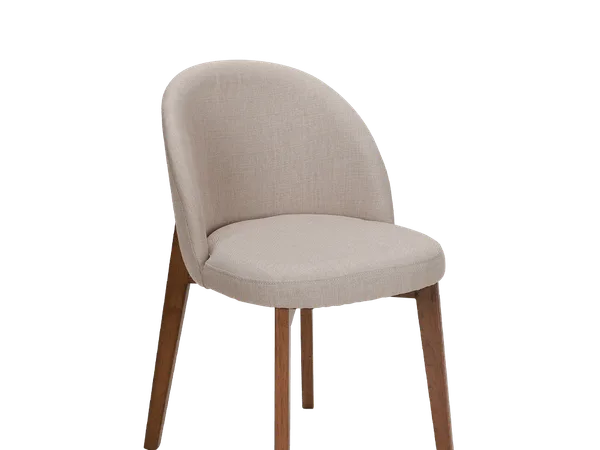
People shop for chairs by looking at the wood. We build them worrying about the joints. A dining chair takes a specific kind of abuse — a person leans back, the back legs lift, and every bit of that force tries to twist the seat frame apart. The species barely matters at that moment; the connection between the rail and the leg is what is being tested, thousands of times a year.
Why we favour the mortise-and-tenon
The mortise-and-tenon is old for a reason. One of the earliest examples comes from the Hemudu culture in Zhejiang — our own province — dating back roughly 7,000 years, and the principle has not improved on because it does not need to. A tongue (the tenon) cut on the rail seats into a matching pocket (the mortise) in the leg, with shoulders that bear against the leg face. Those shoulders are the quiet hero: they counteract the lateral forces that try to lever the joint loose. A good rule we hold to in the shop is sizing the tenon at about one third of the rail's thickness — thick enough to carry load, with enough wood left around it that the mortise walls don't split.
Compare that with a dowel joint, which many factories use because it is faster on a CNC line. Two round dowels and glue can make a perfectly acceptable home chair. But the glue surface is smaller, there are no shoulders sharing the load, and when humidity cycles loosen the glue, a dowel joint goes wobbly sooner than a shouldered tenon. We use dowels where the price point demands it and we are honest about where that line sits.
Pegging, wedging and the details that buy years
A glued tenon is good. A glued tenon that is also pinned with a wood peg through the joint, or wedged so it cannot pull back out, is better — that is the difference between a chair that survives a restaurant and one that survives a dining room. Pegging adds a mechanical lock that does not depend on the glue alone. It costs a little more labour, so we reserve it for contract and heavy-use programs and tell buyers plainly when a home SKU does not need it.
Here is the trade-off we put to buyers: a CNC dowel chair is the cheapest to make and fine for light home use; a shouldered mortise-and-tenon with a peg costs more in machining and hand-work but it is the construction we will stand behind for commercial dining. Paying for pegged joints on a chair that lives in a quiet home is money you don't need to spend — and skipping them on a restaurant order is money you will spend twice.
How we prove the joint before bulk
A joint claim is worth nothing until it has been loaded. On the sample, we don't just eyeball the fit — we cycle the chair the way a body abuses it: weight dropped onto the seat, force applied to tip it onto the back legs, and the leg-to-rail joints watched for any glue-line creep. This mirrors the structural and cyclic logic behind the BIFMA and EN chair tests, and a third-party lab can run the formal version per order. The point of doing a rough version in-house first is simple: if a joint is going to walk loose, we want to see it on sample number one, not on a customer's third reorder. The buyer's guide to sampling before production covers how to structure this stage and what to lock in before you approve bulk.
One detail buyers can check themselves on a sample: grab the chair by the front edge of the seat and rack it side to side. A good shouldered, pegged joint feels dead solid; a marginal doweled one has a faint give or a tick. That five-second test tells you more about year-three durability than any photo of the wood grain. We'd rather you do it on our sample than discover the difference after a container lands.
The hidden partner: moisture
Even the best joint fails if the wood was wet when it was cut. A tenon machined from under-dried timber shrinks inside the mortise, the glue line opens, and the joint loosens — which is why we tie joinery quality directly to our kiln-drying and moisture control. The two are one system.
If you are comparing quotes and one is noticeably cheaper, ask whether the joints are doweled or true mortise-and-tenon, and whether they are pinned. It is usually where the gap is. We build our dining chairs and bar stools to BIFMA and EN test methods, and joint cycling can be tested through a third-party lab per order. Send a sample brief to our export desk and we will tell you exactly which construction we'd recommend for your use case.