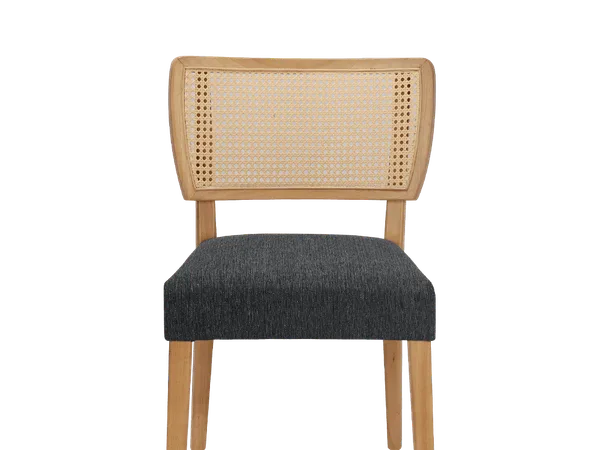
When a buyer sends us a reference photo of a dining chair and asks "what wood is that," the honest answer is usually "it could be four different things, and the one we'd quote depends on your price and your market." Most of our solid-wood frames come out of four species: beech, oak, rubberwood and ash. They are not interchangeable. Each one changes the look, the weight, the cost and the failure mode.
The four we actually run
Beech is the workhorse for a bent or turned chair frame. It is hard — around 1,300 lbf on the Janka scale — with a tight, even grain that machines cleanly and steam-bends well, which is why so many classic café chairs are beech. It takes stain evenly but its pale, slightly pinkish tone shows through a light finish.
Oak sits at roughly 1,290 lbf, near beech for hardness, but the open, ringed grain reads completely differently. Buyers choose oak when they want the grain to be the design — a limed or natural-oil oak chair looks like furniture, not like a painted frame. It is heavier in the container and costs more per cubic metre.
Ash is the hardest of the group at about 1,320 lbf, with a long straight grain and good shock resistance. We reach for ash when a slim leg has to survive a commercial dining room — it bends rather than snaps. The look is close to oak but a touch lighter and more uniform.
Rubberwood is the value option. It is softer, around 950–1,000 lbf, a plantation hardwood (Hevea) harvested after the tree's latex life ends, so it carries a genuine eco story. It glues and stains predictably and stays dimensionally stable once dried. The trade-off is dent resistance: a rubberwood seat edge marks more easily than oak, and it is not for outdoor use. We cover the species in more depth in our rubberwood note.
What the species costs you beyond the price list
Hardness gets all the attention, but two other numbers move a real program. The first is weight, and it shows up in the container. Oak is dense; a 40HQ packed with knock-down oak chairs weighs noticeably more than the same count in rubberwood, and on some lanes you hit the weight limit before you fill the cube — so the "cheaper" oak can cost more per landed chair once freight is counted. We run the loading math both ways before a buyer commits to a species.
The second is grain behaviour under finish. Open-grained oak drinks stain unevenly and wants a grain filler for a glass-smooth top; tight beech and rubberwood take colour flat with less work. That difference is labour, and labour is unit cost. If your design calls for a deep even stain, beech or rubberwood gets you there cheaper than fighting oak's grain — a point we revisit in our finishing note. None of this is visible in a one-line quote, which is exactly why we walk buyers through it.
The trade-off we put on the table
Here is the conversation we have on almost every program. Rubberwood will land your chair at the lowest unit cost and tells a clean sustainability story; it is the right call for high-volume home retail where price wins. But if the chair is going into restaurants — knocked, dragged, stacked nightly — the dent and the joint loosening you save in wood cost, you pay back in returns. For contract dining we push beech or ash and let the buyer see the per-unit delta before they decide. We would rather argue about it now than process warranty claims in year two.
One more practical point: hardness is not the whole story. A well-cut mortise-and-tenon joint in rubberwood outlasts a stapled butt joint in oak. Species sets the ceiling; joinery and drying decide whether you reach it.
How we quote it
Tell us the model, the market and the finish you have in mind, and we will quote the species that fits — not the one that flatters our margin. We run all four in our solid-wood line across the China and Vietnam plants, so we can also move a program between species if your target price shifts. Build and test methods follow BIFMA and EN furniture standards, and third-party testing can be arranged per order. Send the brief through our contact page and we will come back with options.